LeapFrog x Softlogic Life
A breakthrough in outcomes measurement for health investments
- LeapFrog Investments pioneers the application of Disability Adjusted Life Years, with innovative insurer Softlogic Life
LeapFrog has demonstrated a methodology for measuring outcomes of health investments, by quantifying in a single comparable unit the years of healthy life generated by capital deployed. Disability Adjusted Life Years (DALYs), the established framework for public healthcare assessment, can now be applied to direct investments such as diagnostics and to indirect investments such as health insurance.
This provides a methodology for capital allocators, fund managers and insurers to compare and report real-world health value – articulating what investments mean for consumers or policyholders and for a nation’s healthcare system at large.
LeapFrog partnered with Softlogic Life, the largest health insurance provider in Sri Lanka, and PA Consulting to address this challenge. It comes as healthcare investments continue to attract record levels of private capital, and as demand grows for rigorous and comparable evidence of the benefits that capital is actually producing.
LeapFrog Partner Fernanda Lima said, “We have long acknowledged that health insurance is a critical safety net for households but for too long, the health impact of insurance has been assumed rather than measured. We now have a rigorous, replicable framework for quantifying what quality coverage actually delivers, one that works across asset types and markets. For the first time, investors can systematically direct capital toward the interventions offering the greatest health return.”
LeapFrog has refined the application of the methodology to private markets over several years, first with leading Indian diagnostics provider Redcliffe Labs, and now expanded to incorporate financial products that support health outcomes. The DALYs approach will be embedded across all of LeapFrog’s new healthcare investments.
Results from the research found that in one year, Softlogic Life delivered measurable and economically significant health benefits for its policyholders and for Sri Lanka’s health system including:
- Up to 5,000 years of healthy life gained in 2025 – Softlogic Life’s policyholders collectively gained the equivalent of 5,000 years of healthy life over 12 months. The result demonstrates the scale of health improvement and protection possible when individuals have access to appropriate health insurance products.
- Up to $15 million diverted from Sri Lanka’s public health system in 2025 – By supporting policyholders to access private healthcare, Softlogic Life helped divert demand from the public system, similar in magnitude to 1% of government healthcare spending. This frees up resources for those without access to private insurance.
- Up to $58 million of economic value created in 2025 – Based on the value society places on preventing one year of poor health, incorporating productivity, wellbeing and quality of life. This reflects the additional value created by having healthy individuals contributing back to society.
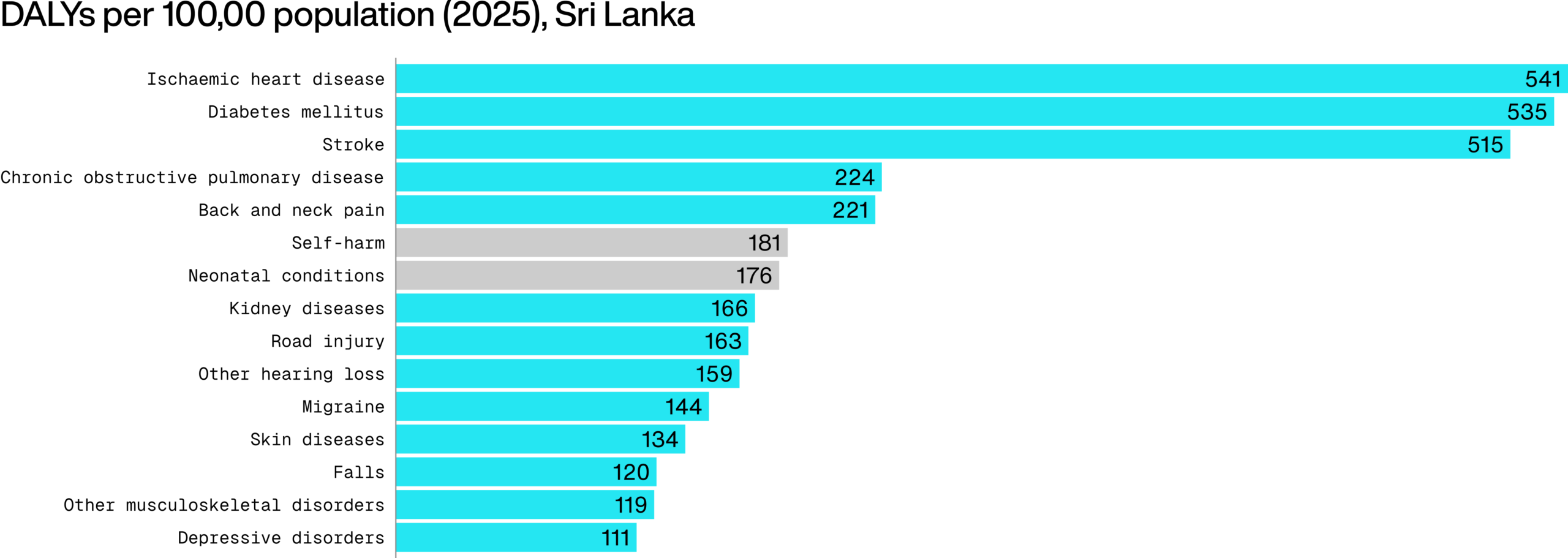
Softlogic Life delivers health protection through two main channels – rider benefits added to individual life insurance plans, and healthcare cover for corporate group policy holders. Policyholders receive a broad range of healthcare support options including consultant fees, medications, lab tests, medical equipment and supplies. An important factor in the DALY analysis is the relevance and comprehensiveness of coverage. Softlogic Life’s policies address 13 of the top 15 conditions contributing to Sri Lanka’s overall disease burden, including heart disease, diabetes and stroke. This reflects a high level of coverage especially when considering certain conditions, such as neonatal conditions, are typically not covered by insurance.
Sri Lanka’s healthcare landscape
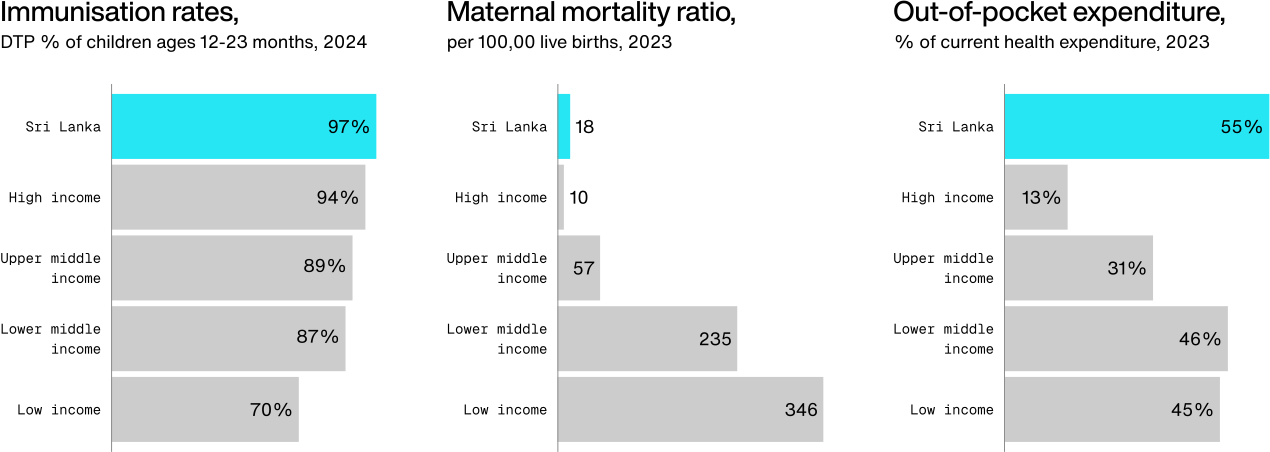
Sri Lanka presents a distinctive health insurance context. Its public health system in Sri Lanka is strong, especially compared to other growth markets, with universal access to public care, near‑universal immunisation, and maternal and child health indicators comparable to far wealthier nations.1 Still, out-of-pocket healthcare spending is high – reaching as much as 55% of current health expenditure in 2023, compared to 46% average for lower-middle income countries.2 This gap between system strength and household financial exposure represents a protection shortfall and a substantial market opportunity for quality private insurance.
Softlogic Life MD Iftikar Ahamed said, “We have always believed that good insurance does more than protect against risk – it gives people the confidence to seek care when they need it. But our responsibility extends beyond our policyholders. When families are shielded from the financial shock of illness, and when pressure is lifted from the public health system, the whole country benefits. Seeing that contribution quantified at this scale is a powerful reminder of the role the private sector can play in building a healthier Sri Lanka.”
Protecting households from unexpected healthcare costs is the primary driver of impact for Softlogic Life, underscoring the important role that effective health insurance can play in helping individuals and households manage financial shocks.
1 World Bank, 2023 & 2024, Immunization, DPT (% of children ages 12-23 months) | Data; Maternal mortality ratio (modeled estimate, per 100,000 live births) | Data; Mortality rate, infant (per 1,000 live births) | Data |2 World Bank, 2023, Out-of-pocket expenditure (% of current health expenditure) – Sri Lanka | Data
The Private Sector's Growing Role
The private sector is an important contributor to healthcare delivery in Sri Lanka and demand is set to increase as demographic and economic pressures intensify. Two major factors are driving this change:
- Within South Asia, Sri Lanka is experiencing the most rapidly ageing population. By 2042, almost one out of every four persons is expected to be 60 or over, creating significant long-term demand for chronic disease management, diagnostics and insurance.3
- Non-communicable diseases (NCDs) including heart disease, diabetes, and cancer now account for nearly four in five DALYs lost nationally by 2019, up ten percentage points in less than a decade.4 These are the conditions Softlogic Life’s policies are designed to cover and the conditions where timely, insured access to care generates the greatest measurable health return.
According to the World Bank, private provision plays a key role in maintaining Sri Lanka’s health system equilibrium, particularly by absorbing excess demand for outpatient care from the public sector.5 As these demographic and economic pressures intensify, that role will only grow.
The findings from this study can be applied beyond the Sri Lankan market. By embedding DALY analysis as a standard across health investments, LeapFrog has established a framework that is replicable across markets and asset types. For capital allocators, this represents a shift to consistent method for understanding what healthcare portfolios are delivering, and a benchmark for what rigorous impact measurement should look like going forward.
3 Sri Lanka Statistical Review, 2023, DCSSSRVol2Issue1Article2 |4 Global Burden of Disease (GBD) and accompanying analysis, 2010-2019, Global Burden of Disease (GBD)| 5 World Bank, 2018, World Bank Document
Authors
Fernanda Lima, Partner, LeapFrog Investments
Stephen Farrington-Bell, Partner, Health Strategy and Investment, PA Consulting
Diana Hindle Fisher, Officer, Impact, LeapFrog Investments
Ruby Powell, Senior Health Economist, PA Consulting
Acknowledgements
Julie Wallace, Head of Impact, LeapFrog Investments
Rebecca Kwee, Associate Director, Impact, LeapFrog Investments
Ario Harsanto, Investment Officer, LeapFrog Investments